Rounding votes for a quorum: the hidden rule that decides the outcome of a meeting
10 August 2026Author
Andrey MorozovPractices
In the course of their business, members of legal entities often face questions about the validity of general meeting resolutions. Such questions can arise both when preparing and holding a meeting and when later assessing the risk of a resolution being challenged or building a position in a claim to have it declared invalid.
Compliance with the quorum and the minimum number of votes required to pass a resolution on a particular agenda item is especially important. Difficulties arise when the law or the charter defines the required number of votes as a share of the number of meeting participants — for example, at least two thirds. The result of the calculation may then be a fraction, even though the number of votes actually cast is a whole number.
The question arises: should the resulting value be rounded, and in which direction? The law does not establish a general rule directly governing how a fractional result should be rounded when determining the required quorum or the number of votes needed to pass a resolution on an agenda item. So in a dispute one party may consider a result rounded down to be sufficient, while the other insists on the next higher whole number of votes.
The answer has practical significance. A calculation error can be grounds for declaring a general meeting resolution invalid. Below we look at how the courts determine the required number of votes when the calculation gives a fraction.
How the courts calculate a quorum in practice
When considering a dispute over the validity of a general meeting resolution, the courts proceed from the premise that the majority established by law must actually be achieved. The mere fact that a calculation produces a fraction does not mean it can be rounded according to the usual mathematical rules.
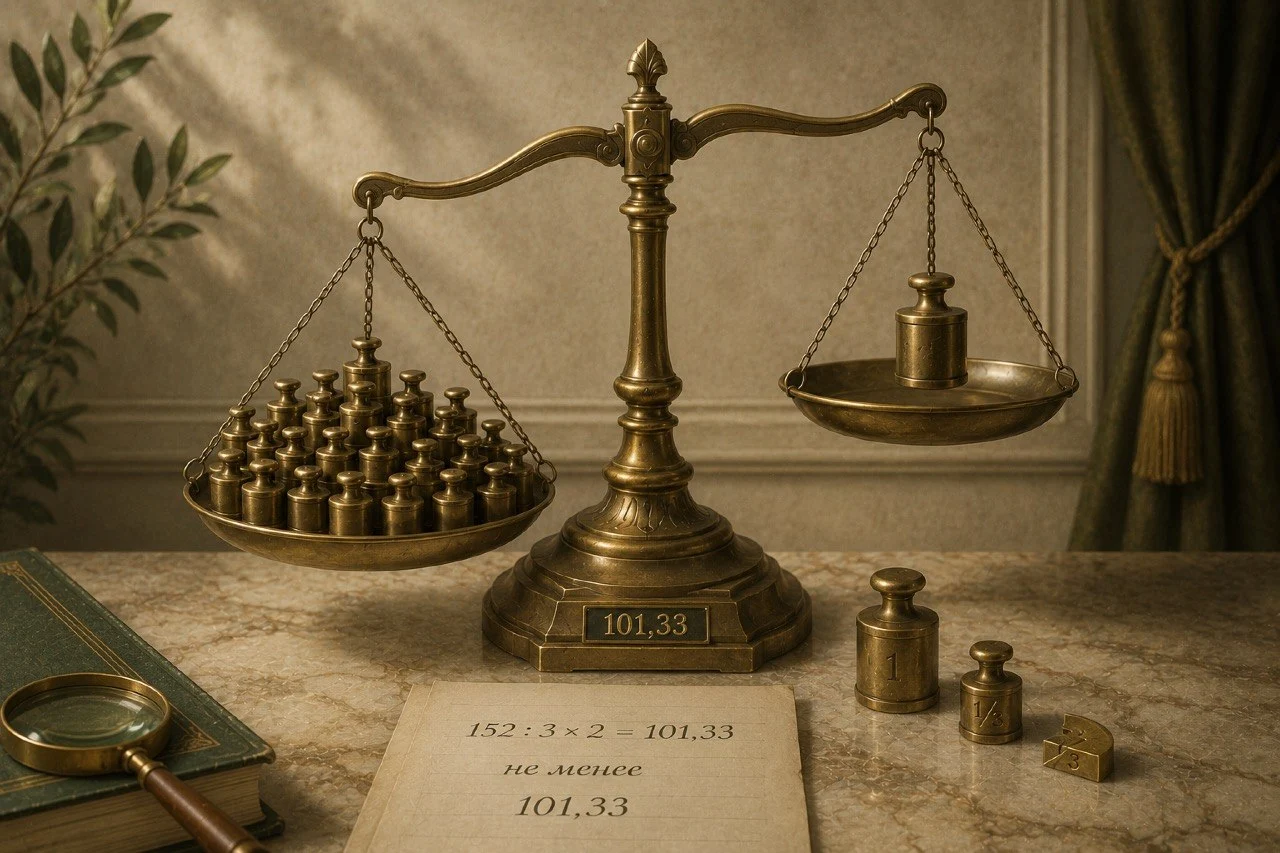
In one such case, 152 members of a partnership took part in the meeting. The disputed resolution required at least two thirds of the votes of those present. The required number of votes was calculated as follows:
152 ÷ 3 × 2 = 101.33.
The court held that at least 102 votes were needed to pass the resolution. With 101 votes the required majority was not achieved, since 101 < 101.33. Consequently, the resolution could not be considered passed, even though the fractional part of the calculated value was less than 0.5.
This conclusion is based not on a special rounding rule but on the substance of the majority requirement. If the law or the charter sets a minimum share of votes, the final number of votes cannot be lower than the calculated threshold. Since a vote cannot be fractional, the requirement becomes the nearest whole number above the fractional result.
This approach applies regardless of the size of the fractional part. For example, if a resolution requires at least 52.14 votes, 52 votes are not enough — a minimum of 53 votes is needed. The result is the same for a threshold of 52.66 votes. In other words, what matters is not the rule of mathematical rounding but whether the required number of votes has been reached.
Recommendations from the C Cases team
Do not apply mathematical rounding to the nearest whole number. If the calculation gives a fractional value, such as 52.14, 53 votes are needed, since 52 votes do not reach the threshold.
Record the calculation in the meeting materials. It is advisable to state in the minutes or in a separate calculation the number of participants, the applicable provision of the law or charter, the formula and the minimum number of votes required. This reduces the risk of a dispute over how the votes were counted.
Distinguish the quorum required for the meeting to be valid from the number of votes required to pass a resolution on a specific agenda item. Different requirements may apply to the validity of the meeting and to passing a particular resolution. A separate calculation is needed for each.
Check the special provisions of the law and the charter. Before applying the general approach, establish whether a special vote-counting procedure is provided for the relevant legal form, type of resolution or particular legal entity.
When preparing a claim or objections, check not only the result of the vote but also the calculation method. If a resolution was passed by fewer votes than the calculated fractional threshold, this may be an independent argument in a dispute over its validity.
If you intend to challenge a general meeting resolution or, conversely, are defending a resolution against a challenge, the C Cases team is ready to assess the circumstances of your situation, identify possible grounds for claims or objections, gather the necessary evidence and build a defence strategy.
Sources
- Civil Code of the Russian Federation (Part One) No. 51-FZ of 30.11.1994;
- Ruling of the First Cassation Court of General Jurisdiction of 16.03.2023 in case No. 88-3042/2023.